Companies often expand to multiple cloud providers gradually, adding one service or application at a time. Without a plan, this approach creates cloud sprawl – an environment that is difficult to govern, secure, and pay for. A multi-cloud strategy turns that unplanned expansion into a framework a business can control.
This article covers what belongs in a multi-cloud strategy, the main approaches businesses take, a practical framework for building one, and the mistakes most likely to derail it.
What Is a Multi-Cloud Strategy?
A multi-cloud strategy is the documented plan that dictates how an organization adopts, manages, and scales services across more than one cloud provider. It is not the same as multi-cloud itself, which describes the infrastructure setup, often provisioned through infrastructure as code (IaC) rather than configured by hand. The strategy is the set of decisions that make that setup deliberate.
A complete strategy defines the business goals behind the cloud migration, sets rules for governance and security, and establishes how workloads get placed across providers. It also covers vendor selection criteria and the tools used to manage the resulting environment. Without these decisions in place, each new provider gets adopted through a separate, one-off decision instead of a shared plan.
Why Businesses Need a Multi-Cloud Strategy?
Every department moves faster when it works from the same set of goals before workloads move. Teams that already know how workloads get placed, which vendor to pick for a given service, and who owns governance are not stuck negotiating these questions project by project, and that coordination becomes more valuable as the number of providers and workloads grows.
Without this type of plan, the pattern reverses. Security configurations drift apart between providers, cost allocation becomes difficult to track, and compliance requirements go unmet in environments nobody is actively watching. Each team ends up solving the same problems on its own, often with different tools and different standards.
Key Components of a Multi-Cloud Strategy
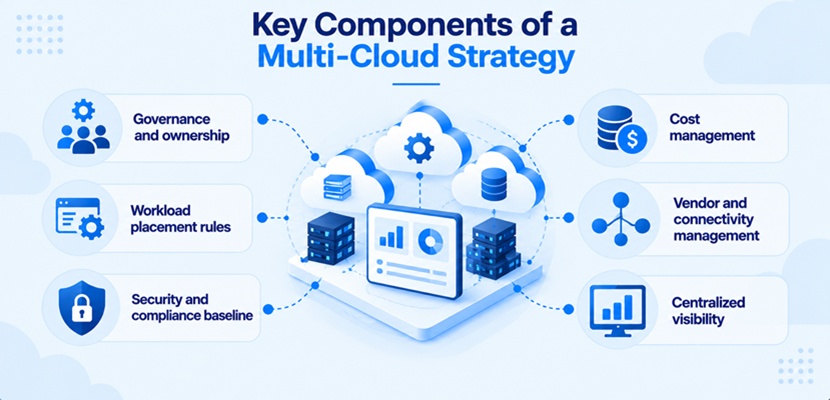
Every multi-cloud strategy rests on six building blocks, regardless of company size or industry. They function as a connected system, not a checklist to complete separately. A complete multi-cloud strategy includes:
- Governance and ownership. A defined owner for cross-cloud decisions, backed by policies every team follows, whether that owner is a dedicated cloud team or a formal cloud governance group that sets and enforces standards for the whole organization.
- Workload placement rules. Criteria for deciding which applications run on which provider, based on performance, data sensitivity, and compliance needs, not on where a workload happens to already sit.
- A security and compliance baseline. A shared minimum standard for identity and access management, encryption, and monitoring that applies to every provider equally, not just the primary one.
- Cost management. A framework for tracking cost across every provider, including a shared system for labeling resources by owner and purpose, and a set schedule for reviewing it.
- Vendor and connectivity management. Criteria for selecting providers and the network connections between them, since performance between clouds depends on how those clouds are linked, whether through a VPN, a dedicated interconnect, or SD-WAN, so bandwidth and latency stay predictable across the connection.
- Centralized visibility. A single view into provisioning, cost, and compliance across all providers, delivered through a cloud management platform (CMP) – software that consolidates control across providers instead of leaving one dashboard per vendor.
These components reinforce each other. Workload placement decisions rely on the cost and security baselines to know what is allowed and what it will cost, while vendor selection determines which of the other components a team can even enforce.
Multi-Cloud Strategy Approaches
Most organizations do not use every provider for every purpose. Instead, they center their strategy on one dominant driver (such as cost, performance, or compliance) that shapes how they select vendors and place workloads. Regardless of which driver they choose, the aim of the strategy is to support business continuity in the cloud.
The approach a business chooses affects which of those components matter most, though every approach still needs all of them in place. The four patterns below cover most real-world multi-cloud strategies, though a company can combine elements of more than one.
Best-of-Breed Strategy
A best-of-breed strategy selects each service from the provider that performs best, rather than settling for one vendor's full stack. A company might run its compute on one provider and its data analytics on another, based on which platform offers the stronger capability for each task.
This approach directly addresses vendor lock-in, since no single provider controls every layer of the environment. The tradeoff is more integration work, since services from different vendors do not always talk to each other out of the box.
Redundancy and Resilience Strategy
A redundancy and resilience strategy spreads mission-critical workloads across providers so that an outage with one vendor does not take down the entire business. A common application is disaster recovery, where a secondary provider, kept in sync through replicated data, stands ready to take over if the primary one fails.
Testing failover regularly is what separates a working resilience strategy from an assumption that redundancy exists. A backup strategy that has never been triggered under real failure conditions is a guess, not a resilience plan, and the gap only shows up during an actual outage.
Cost Arbitrage Strategy
A cost arbitrage strategy shifts workloads to whichever provider offers the best price for a given resource at a given time. Pricing changes often and moves independently across vendors, so this approach requires ongoing monitoring rather than a one-time comparison.
The comparison centers on three resource types:
- Cloud instances. Rates vary by instance type, region, and commitment length; one provider’s price advantage rarely holds across every instance type.
- Storage. Cost depends on the storage tier and how often data gets accessed, not only on how much is stored.
- Data transfer. Moving data between providers or out to the public internet can add significant costs, and rates vary by provider, service, region, and transfer path.
This strategy works best for workloads that are not tied to a specific provider's proprietary services, since portability, supported by containers, standard APIs, and IaC, makes shifting between vendors practical. Workloads with deep provider-specific dependencies are poor candidates for this approach.
Regulatory Compliance Strategy
A regulatory compliance strategy places workloads based on where data is allowed to reside and be processed, rather than on cost or performance alone. A U.S. healthcare organization, for example, may need to evaluate where protected health information is stored and processed, which providers handle that data, and whether the required contractual and security controls are in place.
Industries with strict data residency rules, or businesses operating across multiple countries, often need a compliance strategy regardless of which other plan they also follow. This approach can also run alongside best-of-breed or cost arbitrage, since compliance sets a boundary on where a workload can go, not which provider is best within that boundary.
Protected health information falls under HIPAA cloud storage requirements, which call for encryption, strict access controls, and a signed business associate agreement with the provider, not just a general compliance certification.
How to Build a Multi-Cloud Strategy?
While building a multi-cloud strategy follows a logical order, real projects rarely move through it in a straight line. Each step produces decisions that the next step depends on.
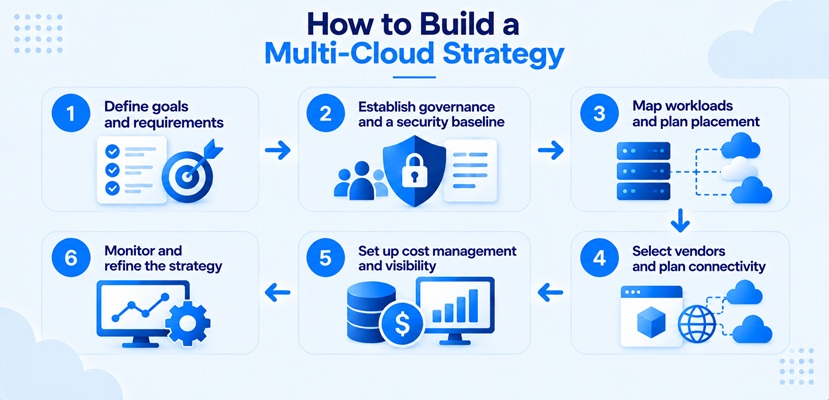
The six stages below move from initial planning through ongoing review.
1. Define Goals and Requirements
Identify why the business needs multiple providers before making any other decision, since this goal becomes the reference point for every choice made later. Most companies center their strategy on one or two goals rather than pursuing all of them equally.
These goals take one of four forms:
- Avoiding vendor lock-in. Spreading services across providers keeps the business free to renegotiate or switch without rebuilding from scratch.
- Reaching new markets. Running workloads closer to customers in different regions reduces latency and improves their experience.
- Speeding up application delivery. Access to more platforms and services shortens time in the CI/CD pipeline, from writing code to shipping it.
- Controlling cost. Comparing pricing across providers, rather than accepting one vendor's default rates, uncovers savings a single-cloud setup misses.
Defining requirements also includes practical logistics: rough timelines, budget, and whether the project will run in-house or with outside help.
2. Establish Governance and a Security Baseline
Assign ownership for cross-cloud decisions before the first workload moves, whether this means forming a cloud team or a dedicated oversight group. The owner sets the security and compliance baseline every provider must meet from day one.
Involve security, operations, and compliance stakeholders from the beginning, not after launch. Document the agreed baseline somewhere every team can reference.
3. Map Workloads and Plan Placement
Review every existing and planned workload against clear placement rules and assign each one to a provider based on performance, data sensitivity, and compliance needs. Not every workload needs to run on multiple providers, and portability as a default requirement wastes effort on workloads that gain nothing from it.
This step also determines whether the strategy leans toward a best-of-breed, redundancy, cost arbitrage, or compliance-driven approach, based on which factors matter most across the mapped workloads.
4. Select Vendors and Plan Connectivity
Match each workload's requirements against what candidate providers offer, using a consistent process for choosing a cloud provider rather than picking a vendor first and adjusting requirements afterward. Free trials and proof-of-concept environments let a team validate a provider's fit before committing.
Connectivity between providers deserves its own evaluation, since network performance between clouds affects every workload that spans more than one environment.
5. Set Up Cost Management and Visibility
Put tagging standards, budget owners, and cost tracking in place before workloads scale across providers, not after costs are already hard to trace. Consistent tagging across every provider is what makes cross-cloud cost reports possible.
A CMP gives the team a single place to monitor provisioning, cost, and policy compliance across all providers, instead of checking each vendor's console separately.
6. Monitor and Refine the Strategy
Review the strategy against actual usage patterns, costs, and business goals on a regular basis, since provider pricing, service offerings, and business priorities all change over time. Automating checks for tag compliance and budget thresholds removes the burden of a manual audit every time, making regular review practical.
Treat the plan as a living document rather than a one-time deliverable. Revisit workload placement decisions periodically too, since a placement that made sense at launch may no longer fit as an application's requirements evolve.
Common Multi-Cloud Mistakes to Avoid
Even a well-planned multi-cloud strategy sometimes fails in execution if a few recurring mistakes go unchecked. Most of them trace back to treating multi-cloud as a technical setup rather than an ongoing operational discipline.
The most common ones include:
- Skipping unified governance. Enforcing security and compliance standards often remains strong for the provider a company adopted first, while newer providers get looser oversight, creating gaps attackers can find.
- Assuming every workload needs to be portable. Building portability into an application that will only ever run on one provider wastes engineering effort that could go toward higher-value work.
- Underestimating data transfer costs. Moving data between providers, not just running workloads on them, carries its own cost, and that cost is easy to miss until a bill arrives.
- Committing to long-term pricing before understanding usage. Locking into a provider's reserved capacity before establishing a realistic usage baseline often leads to paying for capacity that goes unused.
- Treating redundancy as automatic. Spreading workloads across providers does not guarantee resilience if failover has never been triggered and confirmed to work.
- Letting tagging and naming conventions diverge. Every provider handles tags differently, and without a shared standard, cost and compliance reporting across providers becomes unreliable.
Most of these mistakes share the same root cause: treating governance, cost tracking, and testing as steps to handle after the environment is running, instead of building them into the strategy from the start.
Connectivity between providers is one variable a business does not have to solve entirely on its own. phoenixNAP's Bare Metal Cloud, a dedicated server platform with the flexibility of the cloud, connects privately to public cloud environments, letting traffic bypass the public internet. Private connectivity like this can also help with cost management, since data transfer between providers often adds its own charges.
Make Multi-Cloud Work by Design, Not by Accident
A multi-cloud strategy is what separates a controlled, cost-effective environment from one that grew without anyone planning it. Start by defining your goals and assigning ownership before adding another provider to the mix. Getting governance right early spares you from the effort of fixing it once the environment has already grown in complexity.